This Blog is now closed but you can still contact me at patemantrevor@gmail.com. Ukraine-related posts have been edited into the book by Trevor Pateman "Philatelic Case Studies from Ukraine's First Independence Period", edited by Glenn Stefanovics. It is available in the USA from amazon.com and in Europe from me. The Russia-related posts have been typeset for hard-copy publication but there are currently no plans to publish them.
Search This Blog
Saturday, 14 February 2015
Azerbaijan 1922 Postmaster Provisionals - Kusovkin Reprints
Saturday, 8 February 2014
The Beach at Baku: Azerbaijan's 1921 Pictorials
Monday, 15 October 2012
Postal History of Azerbaijan 1917 - 23
Stamps of Azerbaijan 1919 - 1921
Monday, 30 April 2012
Invited Contribution: Tobias Huylmans on Armenia 1923 Yerevan Pictorials with Missing Background
After receiving the stamps I did the following:
First I grouped the stamps as Trevor did in three different groups
- Cafe Latte background
- Pale Grey background
- No (visible) background
Than I scanned the "patients" with 1200 dpi saved this. So now we had these stamps:
| Cafe-Latte | |
![]() | Pale grey |
![]() | Without1 |
![]() | Without2 |
After that I darkened the images a bit using Photoshop:
![]() | Cafe-Latte |
![]() | Pale grey |
![]() | Without1 |
![]() | Without2 |
Now we can clearly see the background on the first three stamps - the background always is spotted - only the last stamp does not have this feature (what seems to be the background is actually the paper - we get to this later)
So far, using an Image Manipulation Program, we learned that the Without1 stamp, which we thought might be without background, has a very weak but noticeable background!
After this I checked the stamps using a Leica MZ FL III Stereo Microscope:
| Cafe-Latte | |
| Pale grey | |
| Without1 | |
| Without2 |
Now we note that even in the "Cafe Latte" version where the background is clearly visible to the naked eye, it almost disappears under the microscope! You now can hardly tell any difference between the "background" of the stamps!
Now I tried to visualize the background with a higher magnification - I used 45x magnification
| Cafe-Latte (clearly visible background) | |
| Pale grey (already hard to tell) |
The stamp "without1" only showed very few and pale background pigments!
After I did all this there was only one stamp which was MOST LIKELY without the background, now I checked with a very
high magnification for any "cafe latte" or "pale grey" pigments.
I looked all over the stamp but could not find
any remains of any pigments used for the background printing - this only can lead us to one conclusion:
The stamp named here "without2" is really printed without the background color!
CLICK HERE
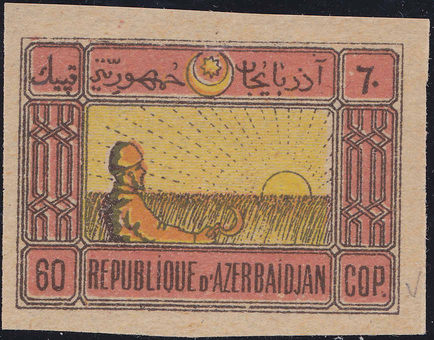
Along with the Armenia stamps, Trevor sent me two examples of Azerbaijan stamps - one with normal yellow background, the other one with apparently missing color yellow.
I basically performed the same steps as illustrated above - The Photoshop step I skipped - well I did not skip it but it did not bring me any useful results ;-)
![]() | Normal stamp |
![]() | stamp with "missing" yellow color |
As next step I made some pictures with the Leica MZ FL III
| Normal stamp | |
| stamp with "missing" yellow color |
What first seems to look like yellow pigments on the right stamp are simply some
darker paper fibers - but for sure no yellow pigments!
Here are two more clear examples
| Normal stamp | |
| stamp with "missing" yellow color |
Now as last step I again used a very high magnification (310x) to search for any pigments - first I show you what these pigments look like:
| Normal stamp | |
| stamp with "missing" yellow color |
So, again the only conclusion can be:
The second stamp shown here is for sure without ANY BACKGROUND PRINTING!
For anyone who wants to see the pictures (and some additional ones) in higher quality:
CLICK HERE
In case you are wondering which kind of technical equipment was used, here is a picture:

At the left side you see my "Zeiss Standard 18" with different objective (6,3x - 25x - 40x - 50x - 63x)
That means with my 12,5 ocular you can see the material looked at with 78,75x - 312,5x - 500x - 625x and 787,5x magnification!)
By now I also have a special UV-Unit integrated into the microscope, this also makes it possible to study the ink and structure of the pigments with UV-light.
At the right side you see the "Leica MZ FLIII" a pretty good stereo microscope - which I mostly use for the comparison of overprints and cancels....
Saturday, 28 April 2012
Azerbaijan 1921 Soviet Pictorials: Blacksmiths

Azerbaijan has oil but, surprisingly, does not seem to have philatelists for its first Republic issues. Outside Azerbaijan, there are few serious collectors: readers don't come to this Blog looking for Azerbaijan. And the incredibly rare Blacksmith proof which was in the Corinphila sale this week (Lot 833, from me) did not sell.
Part of the problem is that we have seen too many old and dirty copies of these stamps in schoolboy collections: tens of thousands of the unoverprinted first issues of 1919 - 21 went into Woolworth packets, many years ago.
Another problem is the paper used for these stamps: newsprint is never attractive and it ages badly. Interestingly, when stamps have been gummed (either mint or used), the gum seems to help preserve the paper.
But these stamps deserve a closer look.
At the top on the left, a block of 4 of the 500r Blacksmiths of 1921. Someone has pencilled plating remarks and the paper has aged. On the right, the forgery of this stamp, not so common, and relatively easy to detect: the shading on the faces and shirts of the two smiths is less detailed, for example.
The background colour wash on this stamp comes in many shades, some of them rare. I have lined up those I have in the second row. On the right, the last two stamps with purple and eggshell blue backgrounds could be colour trials - but I have no means of proving this. There is also some paper variation, though ageing complicates the picture. The third stamp from the left is clearly on a white paper.
This stamp was not used for surcharging: the 150 rouble in the same design but in blue without colour wash background was used but not this 500r value.
However, for a short period at least, this stamp was made available for use unsurcharged. Michel (which gives an issue date of 1 October 1921 for the whole set), values this stamp used at 150 euro (Michel 23 - I notice that the colour combination is listed as "schwarz/violett")
My accumulation of used copies is shown above. There are four with legible April 1922 dates in the top row and two with Janauary dates (laid sideways) in the bottom row.
Two things strike me about this accumulation (pieced together over many years):
First, none of my used copies have a colour wash which is predominantly purple, violet or blue. All are basically grey.
Second, all have BAKU cancels. This is a bit surprising since you would expect to see at least one from somewhere else, like ELISAVETPOL. Maybe this stamp was only available in Baku.
Well, there's a Blog - perhaps the first ever - about just one value of this 15 value set. Someone could have a lot of fun making a specialised collection of all 15 stamps.
But for the moment, I am just thinking that those two blacksmiths never expected to find themselves on the Internet.